we had our first full-class meeting inside the oregon state penitentiary on wednesday night. i didn't try to cover too much in terms of content; instead, i tried to set the tone and create a comfortable space for all of the students who will share these 10 weeks together. in separate meetings on monday and tuesday, i had asked both the outside (OSU) and the inside (OSP) students to do a little self-assessment and write a page or two for me detailing how they were feeling and what they were thinking going into the first combined class session. many of my inside students are not used to writing much, so they were teasing me already, joking that: "she thinks 2 pages is short." i emphasized that thoughtfulness was more important than length and left it at that.
their essays were, in fact, thoughtful and interesting and i've promised to return them to their writers before our last class so they can compare their early ideas to their thoughts after the course. in general, most of the outside students had never been in a prison and didn't quite know what to expect -- their images of prisons and inmates came mostly from the media, so they were nervous and excited to get a reality check. my inside students were also excited and eager for the opportunity to interact with people from the outside world. some were also anxious that after serving a number of years in prison, they may have forgotton how to communicate with "free" people.
while i was able to select my 15 inside students and 15 outside students from motivated pools of potential classmates, i had no control over the correctional officer we would be working with. i cannot express how grateful i am to have the good fortune to work with a patient and friendly officer for these 10 weeks. the OSU students and i met at the penitentiary at 5:30 and our officer spent the next half hour going over IDs, taking us all through the metal detectors, sign-ins, and many locked gates up to the education hall. once there, she showed us to our classroom and then, while clearly nearby if/when we needed her, she left us alone. at the end of our course, she patiently led us out.
so how did the class itself go? we had 30 chairs in a circle. the outside students and i arrived first, so i asked them to sit in every other chair. as our inside students filtered in from their various cell blocks, they took a seat and made small talk while we waited for all to arrive. we got started a bit late, because several of our inside students were sent back to their cells to put on their more formal shirts for the occasion -- something we had not anticipated. i guess next time we'll know. once everyone had arrived, we put on nametags and then spent about an hour on an icebreaker where every inside student spent 2-3 minutes talking to every outside student. the noise was incredible (as i can attest since i was responsible for interrupting them and getting them moving) and it proved a very effective way for the students to all meet each other. even those of us who hate icebreakers, had to admit this one really worked.
after that, we took a break and shared some water -- something we had to get special permission to do. the small talk continued throughout the break and then i asked everyone to get back in their every-other-inside-outside circle and together we came up with guidelines for the class. one of our guidelines/rules is that we can talk about the course as long as we protect the confidentiality of the participants. i'm taking that as the rule for this blog, too. i'll share the basics without identifying specifics.
finally, from the inside-out curriculum, i wrote a quote by dostoyevsky on a whiteboard and asked them to get into small groups to discuss it. the quote is: "the degree of civilization in a society can be judged by entering its prisons." each group discussed what they thought it meant or what it made them think of and then i brought the class back together for a full-group discussion. the students had a lot to say and it took us to the end of the class when the inside students had to go back for counts.
i thought it was a successful first class because we had created a comfort zone in which to share ideas and perspectives and i think everyone is looking forward to the next nine weeks. the feedback that i am getting from my outside (OSU) students is that they are surprised at how much they have in common with the inside students. OSP administrators told me that they had heard nothing but wonderful comments from the inside students about the first class. while some mentioned they were nervous at first, one said it was the best experience he has had since coming to prison, "it was a positive ray of light."
now that we have the first class out of the way, i can breathe a little easier. we'll hit the academic content very seriously over the next eight weeks (and then have a big graduation/celebration/chance to say goodbye in our last class). i'm thrilled to hear that some of my inside students have already asked permission to get together to form small study groups--they are definitely going to make the most of this opportunity.
i can't wait for next week's class!
Sunday, January 14, 2007

Wednesday, January 10, 2007
wanna get tased?
 have you caught the recent press regarding the taser c2, the new consumer taser that comes in pink? i supervised a graduate research partnership with jesse wozniak this summer, in which he attended a taser convention in las vegas and wrote an electrifying paper on policing, masculinity, and tasers.
mr. wozniak will be presenting the shocking results (sorry woz, couldn't resist) at our department workshop this tuesday at 4 in 1114 social sciences. there is absolutely no truth to the rumor that his new advisor will be tased during the presentation. here's the 'stract:
Real Men Use Non-Lethals: Masculinity and the Framing of Police Weaponry
This presentation centers on an examination of masculinity formation in the police subculture. Using first-hand ethnographic accounts of a major non-lethal weapons manufacturer's annual sales and educational conference, I explore how the introduction of "less-masculine" weapons are marketed to coalesce with the hypermasculine police subculture. Connell's (1995) theories of masculinity are tested to understand how such a tightly-defined subculture absorbs such challenges to its core values and re-imagines itself to keep those core values intact.
Tuesday, January 9, 2007
nij and employment programs
 i'm just back from a national institute of justice conference in dee cee. the orienting question was what have we learned from longitudinal research? and, parenthetically, was it worth it?
 my talk reviewed research on employment and crime. i learned much, but the highlight was a discussion with reynaldo decerega, a new youth development specialist at the department of labor. he described programs designed to place young people with records into high-growth industries. i've long lamented that job training in juvenile facilities seem to be preparing delinquent youth for the job market of the 1940s. it is sad to see kids working hard to learn, say, typesetting on ancient printing presses -- especially when almost everybody on the outside has been setting type on a pc since the 1980s.
mr. decerega offered a few examples of jobs in high-growth industries that would suit young offenders. in particular, he cited a program that moved a former drug dealer into a successful career in cell phone sales and services. hmm. such work takes advantage of an existing skill set and, presumably, cell phones will be around for a few more years. i'm just glad to see some thoughtful attention to the "what kind of training might lead to actual jobs" labor demand question, as well as the "instilling human capital into delinquent youth" labor supply question.
Wednesday, January 3, 2007
inside-out
 after nearly a year and a half of training, planning, and negotiating with administrators from the oregon department of corrections, i'm teaching my first inside-out course in the oregon state penitentiary this quarter. the inside-out program brings university students inside prisons to study for a quarter or semester with inmates -- it's a true collaborative learning experience to help to "break down the walls" between the inside students and the outside students.
my course is a special topics course on "crime, justice, and public policy" and will include 12 senior-level undergraduates and 3 graduate students from oregon state university. with very little advertising, i had nearly 40 students who were interested in taking the class and i had to make difficult decisions to choose only 15. assuming all goes well, i am planning to repeat the course in summer, and i have 15 students waiting to take it then.
i also had to choose 15 inside students. after advertising the class in the prison, there were 36 men who were interested and met the eligibilty requirements (including have to spend their scarce resources to buy the text books used in the course). i met with them all in two large sessions, talked about the class, answered their questions, and had them write short answers about why they wanted to take the class, what they hoped to get from it, etc. again, after choosing 15 for next quarter, i have nearly 15 more planning to take the course in the summer. the 15 inside students have varied circumstances: 6 are serving life sentences, two have release dates in 2008, and the rest fall somewhere in between. at least one of the inside students has served more than 20 years. another was a first-time offender incarcerated at 17, so prison is most of what he knows about the world. one common feature these men share is that they are all so excited for this opportunity, so anxious to learn, and eager to try to improve themselves.
this will be a fascinating quarter. our first class meets on january 10th, although i 've got two big training sessions for the department of corrections and the penitentiary between now and then. the set-up has taken an incredible amount of time, but i've had incredible support from both oregon state university and the oregon state penitentiary. we'll be the first inside out class in a men's prison (and, in fact, the only maximum-security prison in the state) on the west coast, so i do feel a lot of pressure to make sure it goes well.
in a way, this post is a good match for chris's last post on soc of deviance in the real world. while he was able to reflect on what his students took from his deviance course to use in their lives outside of the classroom, i'm anticipating all of the life experiences that my varied group of students will bring into my course. i suspect i'll learn at least as much as they do.
because this feels like an important form of public criminology, i'll try to post updates on the blog for anyone who is interested. comments, suggestions, and feedback are all welcome!
soc of deviance in the real world?
 my biggest fear as an instructor -- the one that summons the late-night howling fantods -- is that i will somehow manage to teach students nothing they can take beyond the classroom. i confronted this fear directly last month at the conclusion of my sociology of deviance class. as a two-point bonus question on my final exam, i asked students for a specific example showing how they used course materials outside of my class during the semester.
i teach from two competing logics in the course. first, i try to give them a durkheimian sociological realism, emphasizing social facts and the methods we use to obtain them. second, i employ a constructionist emphasis on labels, power, rulemaking, and careers in deviance. it was cool to see students employ both logics in their answers:
“My boyfriend is in prison and I am constantly asking him about things I learned in class, such as excuses and justifications of rapists, how prison culture convinces people to re-offend, stigmas of certain inmates such as child molesters, intense homophobia in the inmate population, etc. I have used course materials to sociologically analyze his ‘deviance’ and how he will manage the stigma and escape the deviant label once his is reintegrated into society.”
“I constantly seem to be having discussion about gay marriage and the current raging debate. On a society level, I believe that GLBT lifestyles are seen as deviant, but I think that we are starting to see a definite stratification of acceptance based on generation. In these discussions, I always try to show people the construction of deviance, and how any group can decide that an action is deviant, but that deviance and deviant label actions change over time.”
“We watched ‘The Woodsmen’ around the same time we were studying sexual variants and abuse in Abnormal Psychology. I am a Psych major so it’s always interesting look[ing] at the same behavior at the individual level psychologically and then in the larger social context, sociologically.”
“My boyfriend was flipping through one of my Cosmopolitan magazines one day when he saw an article about the dangers of men in groups. He didn’t really get it, and I explained about how I just read about how guys in frats will sometimes use alcohol as a weapon and cover up any wrong doing through ‘brotherhood.’ I told him about the Martin and Hummer reading and group-level processes.”
"I would say the biggest thing I took away was sharing my deviant identity paper with my family."
“I am currently taking social statistics as well, and that class is all about statistical relationships. When we discussed correlates, not as a cause, but as a statistically significant relationship, I could relate the two classes together.”
“This class has provided me with endless conversation at the bar and with my friends. Specifically, we discussed the topics of moral panics and drug scares over a few brews just last weekend. I feel I’ve learned a lot in this class and can ‘hold my own’ in a debate that’s relevant now. Thanks!”
“Just this morning I was telling my partner I was surprised that the 1914 Harrison Act of scheduling drug categories occurred that early. He was amazed too.”
“As a bartender, I witnessed many of this semester’s themes first hand. Saw Hirschi’s theory of self control and alcoholism intersect. I saw the negative stigma associated with alcoholism in full affect and its effect on jobs. I also witnessed techniques of neutralization and vocabularies of motive contribute to deviance in many sphere of social life. These theories helped me identify problems with others and problems with myself.”
“At the Juvenile Detention Center I talked to a young man about what it meant to him to be called juvenile sexual perpetrator. We had a long conversation about his experiences in the JDC with staff because of his crime (rape). He felt that women staff wouldn’t talk to him and only saw him as his crime (master status). I asked him what that label meant to him.”
“I used this material outside of class with regard to my good deeds paper. Even after I turned in my paper, I still tried to do acts of kindness. I attempt to give money to homeless when before I hadn’t.”
“I used the knowledge on suicide in discussion with coworkers to tell them who killed themselves the most, what countries and to bust the myth about how people think suicide rates go up around the holidays"
“I used Merton’s anomie theory to try to justify my piracy of movies on the internet. I told my mom that our society has placed universal goals that we should live in comfort. I also told her that certain people are not advantaged, so they resort to crime to achieve such goals. I said that I am a broke college student so I am considered to be disadvantaged. She still said I was wrong, but she watched the movies with me anyways.”
“I have actually used course material from this great course numerous times in speaking about people that like to dig up ‘hot’ corpses, to asphyxiation, to labeling theory, as in at work as we detained a young man screaming, ‘I’m a down ass gangsta.’ I remarked how he had labeled himself as such from differential association and his subculture."
“My husband and I always debate theories regarding entry into drug dealing (he went ‘away’ for four years for cocaine dealing) and I’d tell him about your research on ex-cons and voting. "
“Applying the movie ‘Fight Club’ to a talk with a female friend, I was able to convince her that males were running out of all male masculinity spheres of behavior through which we can interact solely with other males, with the inclusion of women into the work force and equality of positions of authority, male dominance in the social are under attack. Femininity is leaking into masculinity diluting male championed ideals, leaving them frustrated with no avenues of self expression is the modern world. For Merton, males experience strain with the rational and the feminine.”
“I was having a debate with a friend about how prevalent the GLB commentary is in the U.S. She stated the statistic, ‘1 in 3 people are in the GLB community.’ I stated the NHSL survey and the statistics about how low the reporting actually is. We contributed the reporting to either harassment of just a fear of ‘outing’ themselves.”
“Oddly enough, I talk about this class a lot with friends, and when eating with my family. The most recent tie I made with class and discussions was with my girlfriend. She is at the U of M with a rowing scholarship and is from Lithuania. We talked both about women’s sports and the high suicide rates in her country. She was able to give me insight into both areas.”
“Just last night I was talking to my friend about deviance in terms of careers or a process. I explained mostly about drug trafficking and how its exit can be difficult. We talked about the movie, ‘Blow,’ referring to entertainment as a common ground we could both relate to. "
“I actually use the terms often at work as a mall security guard. For example, last week I was trying to explain why a few kids couldn’t throw things at each other. I remember telling them that [they] couldn’t throw things at other people. They said there were no rules against it. So I told them their actions are deviant and they are violating the norms of the mall. They honestly had no clue what I meant, but at least they couldn’t keep arguing with me and felt like I outsmarted them.”
“When my sister discovered I was taking a class titled, ‘Deviant Behavior,’ she immediately responded, ‘I’m not deviant!’ I immediately corrected her telling her we are all deviants in some way. Deviance, I told her, is a violation of social norms and anytime she or I violated any norm we are deviants ... the overall point is we all are, have been, and will continue to be deviants even if it is as simple as bringing a caffeinated soda into church (a Mormon church) as my sister has done.”
“I volunteer at Ramsey County Jail with the women, and help lead a chemical dependency relapse prevention class. I took a lot from this class and applied it to my work there. For instance, many are in for prostitution and it was very helpful for me to view them as victims/survivors of domestic abuse.”
“In a discussion about if viewing porn is o.k. for boyfriends/girlfriends in a relationship, I was able to talk about statistics of male/female[s] who view it, and how changing norms or sex are on the rise. Ex: more premarital sex and how it’s not as deviant.”
“Near the beginning of the semester I was discussing (or explaining) the labeling theory to my friend. We likened it to the label of him by his friends as an alcoholic/party animal. This label, we discussed, reinforces and encouraged his behavior as such, and even though he has acquired a lifestyle slightly less extreme, he is often enticed and/or expected by them to live up to (or down to depending how you look at it) that standard of behavior.”
“I used several statistics from this class like the Devah Pager study on race and employment as a ‘staggering sociological statistic,’ opener for my students in the lab section of SOC1001 I T.A.ed this fall.”
“What I took from this course the labeling theory that I was able to explain to my parents. You see, the Hmong community lives on reputation and labeling is very common. I sat down and had a conversation, relating to my brother’s deviant actions, about how labeling a person will actually enforce him/her to do more deviant acts. Instead, encourage the person to get out of those deviant acts and do good.”
“I avidly participate in local police ride-alongs and I brought up the topic of labeling theory to an officer. Ummmm yeah didn’t go over very well, he is a racist-XXXX and basically said that just because you ‘step in your own XXXX doesn’t give you an excuse to wipe it off on society’s doormat.’ No really, he said it! Needless to say the conversation was a hostile one and I hope he changes professions.”
“Last weekend I had a discussion with my friends about binge drinking. I told them that binge drinking was defined as 5 or more drinks in one occasion. They thought this was a very low number and I told them that [this] was because they were binge drinkers. If they thought they had enough alcohol after 2 drinks, then they would consider 5 to be binge drinking. However, since 5 drinks is a norm, we would say that 10 drinks in one occasion was binge drinking.”
“This morning actually, my brother’s girlfriend was talking about a girl who committed suicide. I asked how, and came to find out that she tried overdosing a couple times before she ended up strangling herself. I told my brother’s girlfriend that girls usually attempt more suicides than complete them because of what they do. Males complete more of suicides because of the majority of them using firearms.”
i was a bit surprised by the diversity in the responses. students didn't simply parrot back my pet concepts or findings, but seemed to employ some course materials when situations presented themselves in their other classes, their jobs, or socializing with families or friends. i'll definitely use such a question again.
i was a bit surprised by the diversity in the responses. students didn't simply parrot back my pet concepts or findings, but seemed to employ some course materials when situations presented themselves in their other classes, their jobs, or socializing with families or friends. i'll definitely use such a question again.
Sunday, December 31, 2006
steve sack and a pretty-much-free press
 my favorite year in review stories are those showcasing the local paper's political cartoonist. maybe that's because the best cartoons always strike me as inherently sociological -- putting big concepts into play around a particular case. as today's story makes clear, my minneapolis strib is fortunate indeed to get regular images from steve sack.
op-eds are great, of course, but there's a magical whoa! moment when a fine cartoonist nails a complex set of ideas in a single image. the conceptual weight of such pictures can make the accompanying editorial seem ridiculously oversimplified by comparison. would a windy sociological essay on the meaning of civilization and its incompatibility with torture pack the same punch as the cartoon above?
i treasure my daily encounters with such powerful material over strong coffee and wheaties. too often, i suppose, we take these first amendment moments for granted. as cartoonists found themselves at the center of intense religious conflict this year, i was glad to see that few seemed to shrink from the controversy. if you agree, you might browse daryl cagle's rich archive of political cartoons, including many by mr. sack. did any cartoons move you this year?
Wednesday, December 27, 2006
justice talking
 i just heard my october interview on npr's justice talking show about felon voting. for some chair/meeting-related reason, i had to run to the kfai studios that day, so i arrived winded and overcaffeinated in the midst of a pledge drive (hint: diet coke is a no-no before on-air interviews).
i liked the show and its host, margot adler, so i'm disappointed that the program isn't carried locally. they asked me for a quick "big-picture overview" on felon disenfranchisement, which is fine with me. my bit preceded a more intense debate between spencer overton and john lott on the subject. i really dislike debating, so i usually decline invitations to argue for or against policy changes. part of this is due to my self-concept as a social scientist, but part of it is because i'm a ridiculously conciliatory debater (yeah, i can sort of see your point there, mr. rumsfeld. are we almost done here?). i'm probably not alone -- many of us are probably more at home doing the "current state of knowledge" segment rather than the "what is to be done?" portion of such programs.
Tuesday, December 12, 2006
c-love
 courtney love has successfully completed rehab and probation and is now officially off-paper. judge rand rubin terminated ms. love's probation early when she finished a substance abuse treatment program. according to reuters, ms. love entered guilty pleas in 2004 and 2005 to some [silly] drug charges and pleaded no contest to [scary] assault charges in 2005:
Love was accused of dousing King with a bottle of Johnnie Walker Red Label scotch, throwing a lit candle at her head and pinching her breast. The attack came after Love found King sleeping on a couch at the home of Love's ex-boyfriend.
of course, this is no isolated incident. ms. love has had more than her share of legal problems over the years: juvenile and adult, criminal and civil, property and violent, trumped-up and let-off-easy. maybe i've got a soft spot for 42-year-olds named c-love, but i'm hoping this was her last pass through the criminal justice system.
Thursday, December 7, 2006
mayor coleman bans the box in st. paul
 the pioneer press reports today that the city of st. paul will no longer require jobseekers to state on their applications whether they have ever been convicted of a crime. cities such as boston have already implemented this sort of pro-reintegration policy, but it remains a gutsy move by mayor chris coleman. background checks will continue to be conducted for positions involving direct contact with children, law enforcement, and positions of financial trust.
Tuesday, December 5, 2006
i hope i never see embattled modifying my name
 the times and post reported today on the allegations against embattled minneapolis fire chief bonnie bleskachek. mayor r.t. rybak has asked the city council to fire chief bleskachek after four lawsuits were filed against the city, accusing the chief of "playing sexual politics, retaliating against a former partner, acting as a lustful predator and showing bias against at least one heterosexual male firefighter."
yeesh. as in many sexual harassment cases, the allegations are pretty bad. it looked as though the city would settle up and cut a deal with the chief, but the taxpayers protested with a collective "oh, come on!" when ms. bleskachek was offered a severance package of about $41,000 and another job in the department.
i can't determine whether this is a case of a serial harasser and authority-abuser, or a case of homophobic piling-on against the nation's first openly lesbian urban fire chief, or, i suppose, some combination of the two. having spent a little time studying sexual harassment, i can say that the allegations made in this case are not atypical. as a department chair in an authority position, however, i'm sympathetic to ms. bleskachek's position: “I wanted to have my day in court, to be deposed, to force these people to produce some proof,” she said. “It’s a devastating blow to my career, my reputation, my everything.”
Monday, December 4, 2006
mickey
 my nyc punishment conference ended strangely friday night. after the final session, i joined a couple friends at a nearby hotel bar. i felt pretty intoxicated after a drink and a half and went back to my room. i attributed my wooziness to a long day of sessions and an empty stomach, but the next day one of my companions emailed to suggest that something may have been slipped into her drink:
I actually ended up going to the police and reporting this incident. I am now about 100% sure that roofies were slipped into that second drink. My reaction was very unusual. I usually have quite high tolerance to alcohol, yet after a few sips of the 2nd drink, I almost instantly felt out of it. I passed out as soon as I got home and was out cold for about 7 hours. Yet, I woke up around 5AM perfectly fine and not feeling hungover at all.
i won't name the people or places, at least until i learn more about what happened. but i've got more questions than google can answer.
* why would someone target a woman sitting with two other men? rohypnol-like substances can be used for drug-facilitated robbery as well as for drug-facilitated sexual assault. the three of us were well-dressed for the conference (by academic standards, that is), but weren't flashing cash around.
* who could have done it? the other male in our party is an old friend and above suspicion (i hope that i am as well!). i don't think the drinks ever left our sight, but i wouldn't blame the bartenders without much more evidence. do bartenders often feel they've been falsely accused in such situations?
* my friend woke up with two black eyes. are any of the roofie-like drugs linked to this sort of discoloration?
* how common are such experiences? i couldn't find any good stats beyond monitoring the future high school students, which suggest a low rate ( < 2%) of self-reported use.
Thursday, November 30, 2006
recipe for prison pruno
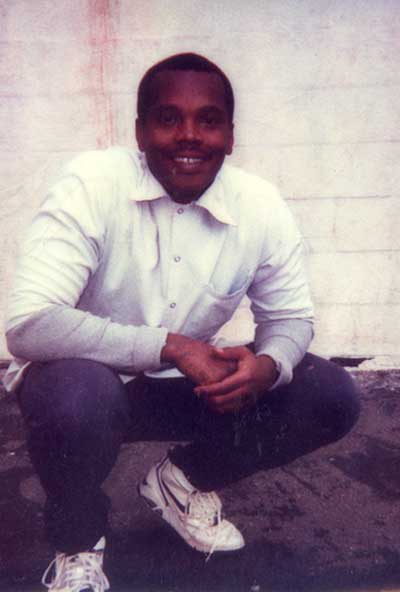 i'm in nyc for a punishment conference at the new school. after today's academic sessions, richard gere and carey lowell offered a dramatic reading of prison writings.
the actors were working with some great material, of course, since there are some amazing writers behind bars. prison writing is challenging because simple, matter-of-fact reporting can come off as melodramatic to those of us on the outside. the best writers, of course, juxtapose telling descriptions of the mundane and taken-for-granted -- the ceaseless noise, the odors, the lack of natural light -- with the high drama and harsh reality that punctuates prison life.
for example, patricia prewitt's contraband brilliantly conveys the small absurdities of prison life from an inmate's perspective. other writers addressed heavier issues involving fear, pain, violence, and hopelessness. i found the pieces by jarvis jay masters to be especially moving. pieces such as "mourning exercise" make clear that mr. masters is not just a good prison writer. this one knocked me out:
recipe for prison pruno
Take ten peeled oranges,
Jarvis Masters, it is the judgment and sentence of this court,
one 8 oz. bowl of fruit cocktail,
that the charged information was true,
squeeze the fruit into a small plastic bag,
and the jury having previously, on said date,
and put the juice along with the mash inside,
found that the penalty shall be death,
add 16 oz. of water and seal the bag tightly.
and this Court having, on August 20, 1991,
Place the bag into your sink,
denied your motion for a new trial,
and heat it with hot running water for 15 minutes.
it is the order of this Court that you suffer death,
wrap towels around the bag to keep it warm for fermentation.
said penalty to be inflicted within the walls of San Quentin,
Stash the bag in your cell undisturbed for 48 hours.
at which place you shall be put to death,
When the time has elapsed,
in the manner prescribed by law,
add 40 to 60 cubes of white sugar,
the date later to be fixed by the Court in warrant of execution.
six teaspoons of ketchup,
You are remanded to the custody of the warden of San Quentin,
then heat again for 30 minutes,
to be held by him pending final
secure the bag as done before,
determination of your appeal.
then stash the bag undisturbed again for 72 hours.
It is so ordered.
Reheat daily for 15 minutes.
In witness whereof,
After 72 hours,
I have hereon set my hand as Judge of this Superior Court,
with a spoon, skim off the mash,
and I have caused the seal of this Court to be affixed thereto.
pour the remaining portion into two 18 oz. cups.
May God have mercy on your soul.
Guzzle down quickly
Mr. Jarvis Masters.
Gulp Gulp Gulp!
California State Prison-San Quentin
1992
Tuesday, November 28, 2006
pubcrim and (in)expert knowledge
 i presented some research today before the minnesota supreme court's statewide racial fairness committee, a distinguished group of supreme court justices and other justice professionals. they weren't wearing robes, of course, but it was still a bit intimidating, perhaps because my adolescent appearances before judges were not always so pleasant.
my schedule has been a bit hectic this week (or, more precisely, completely freakin' nuts), so i was racing from campus to capitol with little time to spare. i think the talk went well, although i had the horrifying realization at about the 25-minute mark that i was beginning to lecture the justices about the law (i tend to have all my horrifying realizations at the midway point of presentations -- being onstage sharpens the senses, i suppose). this would have been profoundly stupid and arrogant, in light of my very limited knowledge and experience with the law. i therefore beat a hasty retreat back to some solid social facts (e.g., race differences in punishment and disenfranchisement) and the conceptual tools of sociological theories (e.g., group threat) that help us make sense of them.
this seemed a good strategy, at least as measured by a dramatic increase in note-taking, questions, and eye contact during the talk. although i don't always make the best use of them, i'm once again convinced of the extraordinary utility of my discipline's methods and theories.
Sunday, November 26, 2006
the o.j. - arbuckle discrepancy?
erin aubry kaplan of the los angeles times penned a head-scratcher of an op-ed this week. in the la times, it was titled, "The O.J.-Kramer discrepancy -- Recent PR disasters reveal greater tolerance for a white man's unsavory behavior than a black man's," while the strib named the piece, Kramer-O.J. discrepancy says a lot about inequality -- Richards' racist rant is brushed off as an isolated incident, while Simpson is condemned for his character.
huh? i understand the idea of a racist double standard when it comes to crime and justice, and to public opinion about crime and justice. as a criminologist, i've seen racial disparity in the operations of the justice system and i'm personally committed to uncovering and redressing these inequities. while michael richards' racist comedy club meltdown was awful, however, mr. simpson was accused of murdering two people.
ms. kaplan reassures us, after 11 paragraphs, that she isn't "equating racist invective with charges of double homicide." fair enough, i suppose, but isn't this comparison precisely the point of her editorial?
Richards' "racist rant" has been described as a terrible but isolated incident. O.J., meanwhile, is condemned for his character.
if ms. kaplan believes that o.j. simpson has been unfairly condemned because of his race, couldn't she have found a more fitting comparison? i dunno, perhaps the situations involving senator ted kennedy and roscoe "fatty" arbuckle were somewhat more comparable to the accusations against mr. simpson -- at least when stacked up against mr. richards' cringe-inducing speech.
though the now-senior senator was never tried for murder, his behaviors were alleged to have contributed to the death of another person. senator kennedy's public image has never quite recovered from chappaquiddick, but he remains a powerful and generally respected public figure to this day. mr. arbuckle's career was pretty much cooked after he was tried for manslaughter in the death of a young actress, but it may have been even worse for him if he hadn't been white. mr. arbuckle never wrote an if i did it book like mr. simpson; given the public outcry over his alleged crimes, however, would it stretch credulity to suggest that a black fatty arbuckle might have faced a lynch mob?
so, i am sympathetic to ms. kaplan's larger point about race and justice, and i think some data could be martialed in favor of her assertions about mr. simpson's public image. but c'mon, comparing OJ and michael richards? unlike brentwood in 1994, only one person died at the laugh factory that november night: the formerly-likeable actor who played cosmo kramer.
huh? i understand the idea of a racist double standard when it comes to crime and justice, and to public opinion about crime and justice. as a criminologist, i've seen racial disparity in the operations of the justice system and i'm personally committed to uncovering and redressing these inequities. while michael richards' racist comedy club meltdown was awful, however, mr. simpson was accused of murdering two people.
ms. kaplan reassures us, after 11 paragraphs, that she isn't "equating racist invective with charges of double homicide." fair enough, i suppose, but isn't this comparison precisely the point of her editorial?
Richards' "racist rant" has been described as a terrible but isolated incident. O.J., meanwhile, is condemned for his character.
if ms. kaplan believes that o.j. simpson has been unfairly condemned because of his race, couldn't she have found a more fitting comparison? i dunno, perhaps the situations involving senator ted kennedy and roscoe "fatty" arbuckle were somewhat more comparable to the accusations against mr. simpson -- at least when stacked up against mr. richards' cringe-inducing speech.
though the now-senior senator was never tried for murder, his behaviors were alleged to have contributed to the death of another person. senator kennedy's public image has never quite recovered from chappaquiddick, but he remains a powerful and generally respected public figure to this day. mr. arbuckle's career was pretty much cooked after he was tried for manslaughter in the death of a young actress, but it may have been even worse for him if he hadn't been white. mr. arbuckle never wrote an if i did it book like mr. simpson; given the public outcry over his alleged crimes, however, would it stretch credulity to suggest that a black fatty arbuckle might have faced a lynch mob?
so, i am sympathetic to ms. kaplan's larger point about race and justice, and i think some data could be martialed in favor of her assertions about mr. simpson's public image. but c'mon, comparing OJ and michael richards? unlike brentwood in 1994, only one person died at the laugh factory that november night: the formerly-likeable actor who played cosmo kramer.
Thursday, November 23, 2006
spare me my life!
throughout japan's protracted economic recession, crime rates remained low by international standards. as a visiting american criminologist, my japanese friends would often ask questions that seemed to presume scarface-level crime rates all over america. for example, a middle school student in osaka asked me whether my (middle-school-aged) children brought guns to school, to little league games, and other venues (they also asked about illicit drugs, but that's another post). i guess one can blame american cultural products, which tend to feature lots of violence. plus, by any measure, we really do have a lot of guns in this country.
perhaps all this explains the disturbing content and peculiar selection of commonly used english phrases in the video above. never in my forays into spanish, french, japanese, and norwegian language instruction, do i recall learning the phrase, spare me my life.* maybe i did learn it, but just can't remember because there wasn't a video featuring george castanza with half a brassiere on his head and a catchy dance number to accompany the lesson. as for the other bizarre features in the clip (is this thing for real? what's with the zoom into the shoulder? the marching and smiling?), you're on your own.
*sadly, i failed miserably at all but norwegian, in which i failed semi-respectably. i have tremendous respect for folks with real language skills. let's see, i think they started me off with food ("pass me the butter") in intro norsk, and we spent a lot of time on monsieur thibaut's hat in french. i came across some interesting phrases involving etiquette in japanese public baths, but nothing life-threatening.
perhaps all this explains the disturbing content and peculiar selection of commonly used english phrases in the video above. never in my forays into spanish, french, japanese, and norwegian language instruction, do i recall learning the phrase, spare me my life.* maybe i did learn it, but just can't remember because there wasn't a video featuring george castanza with half a brassiere on his head and a catchy dance number to accompany the lesson. as for the other bizarre features in the clip (is this thing for real? what's with the zoom into the shoulder? the marching and smiling?), you're on your own.
*sadly, i failed miserably at all but norwegian, in which i failed semi-respectably. i have tremendous respect for folks with real language skills. let's see, i think they started me off with food ("pass me the butter") in intro norsk, and we spent a lot of time on monsieur thibaut's hat in french. i came across some interesting phrases involving etiquette in japanese public baths, but nothing life-threatening.
Friday, November 17, 2006
call to justice tv - saturday night at 8
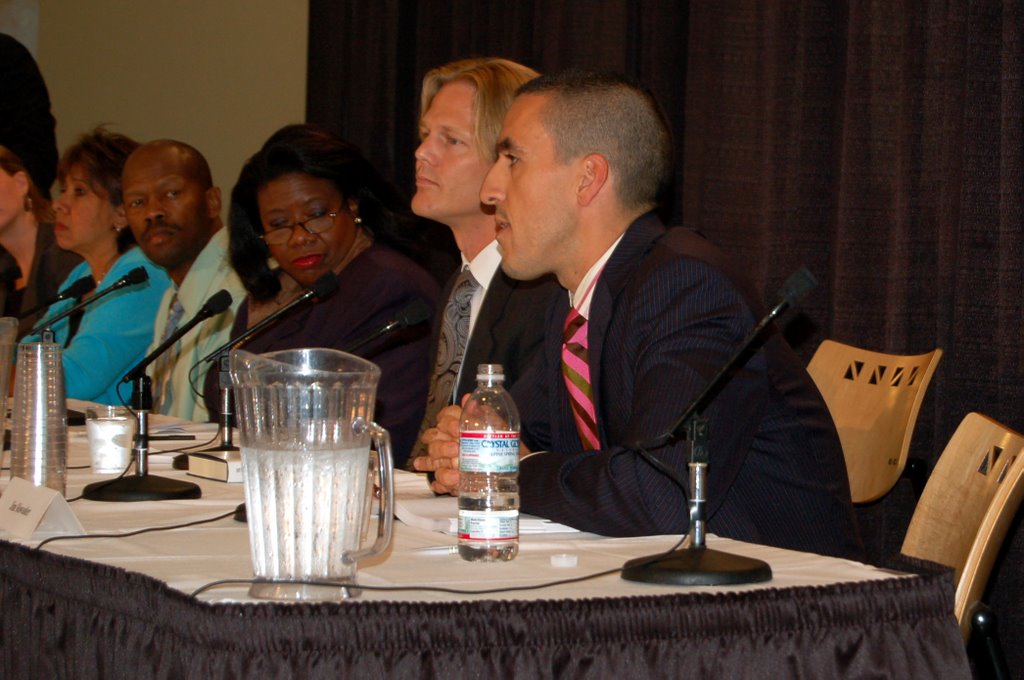 twin cities public television will show highlights of the council on crime & justice's call to justice forum on racial disparities tomorrow night. i can't vouch for the production values and, being one of the less exciting speakers on the bill, i don't know whether any of my remarks will survive the editing process. nevertheless, it was a lively event that could make for good tv. you can check it out on channel 17, saturday november 18th, from 8:00 to 9:00 pm.
here's a blurb on the conference and panelists:
In early 2006, the Council completed a five year research project known as the Racial Disparity Initiative (RDI). RDI consisted of 17 studies that examined both the causes and consequences of the racial disparities throughout Minnesota’s criminal justice system. In June of 2006 the studies’ key findings and recommendations were revealed at the Call to Justice Forum, attended by over 700 community members and leaders representing a diverse range of perspectives and expertise in the area of criminal justice or related areas.
The goal of the event was to bring community members, organizations, and leaders together to collaboratively and actively address the disparities. Panelists included: Senator Julianne Ortman; University of Minnesota Professor Chris Uggen; University of St. Thomas Professor Kenneth Goodpaster; Saint Paul Mayor Chris Coleman; Minneapolis Mayor RT Rybak; Dr. Bravada Garrett-Akinsanya, African American Child Wellness Institute; Minnesota Supreme Court Justice Paul Anderson; Minnesota Supreme Court Justice Alan Page; University of Minnesota Professor Michael Tonry; Jim Rowader, Target Corporation; Donna Zimmerman, Health Partners.
Saturday, November 11, 2006
twenty large is too much to charge
 many big-name and medium-name academics are charging large speaking fees. when local grad students invited a prominent (non-sociology) professor to campus for a talk, they were told it would cost $20,000 plus expenses. since s/he ain't flying coach, the expenses might cost an additional $5,000. around here, that's about a year's worth of support for a grad student and three years of undergrad tuition. in my view, demanding such fees is an absurd abuse of the academic star system and only suckers would pay such fees.
here is how critics of academics (including myself, of course) might see big speaking fees:
1. individuals grabbing credit for group accomplishments. unlike novelists who might conceive and execute projects on their own, most of us rely on others to do much of the real work on our projects. dozens of students and thousands of research subjects often assist in our research. so, where's their cut of the $20,000? they don't get a sniff of it.
2. feeding at the public trough. few of us could gain much private recognition without huge public investments. for example, the states of minnesota and wisconsin subsidized my education; the national science foundation, the department of justice, and the national institutes of health have supported my work; and, the university of minnesota has paid me a steady and generous salary throughout my career. so the taxpayers and students are triple-gouged by (1) the fee they must pay to speakers; (2) the lack of return on their previous investments; and, (3) the lost time i take for personal profit when i could be teaching or doing other work for the minnversity.
3. profiting from misery. shouldn't we feel conflicted and rotten whenever we take a limousine to a poverty conference or step over a homeless kid on the way to a sumptuous hotel? those of us who do social-problemsy research should really know better, unless we have such an outsized sense of personal entitlement that we don't even notice the contradiction.
4. nothing intellectual about it. such fees are for celebrities rather than scientists, so these folks aren't brought in for anything resembling a "serious" research talk. i'm all for popularizing high-end research, but big public talks should help fulfill the mission of teaching and disseminating findings rather than the mission of generating a supplementary income stream.
5. tenured professors already get paid. non-academics who must make a living giving talks and writing books likely need hefty speakers fees. i know some brilliant free-lance journalists who live article-to-article and supplement when and where they can. but big-shot tenured professors can already rely upon their six-figure academic-year salaries. forever.
6. lousy investment. our potential visitor was not a major political or cultural figure, either, who might arguably return $25k in attention and resources or even prestige to the minnversity. the minnversity may have gotten their money's worth in bringing in colin powell, salmon rushdie, and other non-academics to campus this year, but that's a tough argument to make for just another professor from a peer institution.
7. they'd be ashamed. if i blogged the names and fees of people who have turned down invitations for monetary reasons, they'd surely want to sue me. imagine if your peers read something like this: well, we invited uggen but there's just no way. his agent said he normally charges $10k, but would give us his special discount fee of $8,500. he's already got offers for $9,000 at the mall of america business college and $9,500 at the boat show. when we told him we only had $5,000, he said it just wasn't worth his time.
8. rubes, suckers, and marks. relative to small unranked institutions, fees are often much lower for well-endowed private universities such as stanford, harvard, and chicago. some bigshots only address the "rubes in flyoverland" when paid very handsomely, since there is no compensating gain in prestige. i can get a little cranky when a visitor sees the minnversity as anything other than a great public research university. paying fees that harvard wouldn't have to pay puts me into the position of a rube, a sucker, a mark, and (okay, i'll say it) a john.
9. even a high-end $20,000-per-night escort is still a ... i wouldn't push the analogy too far, but there's a word for people who seek monetary compensation for their kind attentions.
10. no accountability. when deans and department chairs put $20,000 into a new initiative, we like to know what happens to it. did it serve as seed money to launch a new initiative? did a publication result? was it used to further a teaching or service mission? sometimes expenditures turn out to be "blind alleys" that don't pan out, of course, but at least the recipient is accountable and there's a reasonable chance of an intellectual payoff. for a speaker series, there are plenty of non-$20k visitors doing the kind of exciting work that generates great ideas and intellectual exchange.
i'm not suggesting that everyone should put their honoraria into a felon fund or that professors shouldn't be compensated for their time. i can certainly understand why busy academics cannot accept every invitation to travel and speak. but wouldn't, say, $500 or $1000 be ample compensation? choosing academic invitations based solely on ability to pay any more than that doesn't pass the smell test. i guarantee that if you devote half your honoraria to an organization or a cause related to your research, you'll feel a whole lot better about taking the balance of the money.
Friday, November 10, 2006
school-to-prison pipeline
 the american society of criminology meetings had some provocative film sessions last week, making good use of the l.a. convention center theater. i sat in on a series of short films and trailers, thinking they might be good for classroom use. unfortunately, i had to leave early -- it was pretty intense to see back-to-back-to-back docs on prison rape, kids in cages, and other atrocities.
one film that looks terrific, though, is book 'em: undereducated, overincarcerated by youthrightsmedia.org. the three-minute clip addresses a phenomenon known as the school-to-prison pipeline. i just heard the term this summer, at a racial disparities conference in minneapolis. i learned that youth of color now make up about 80% of the juveniles appearing in hennepin county court, with 25% of those cases referred from schools. this doesn't include truancy violations, either. in just the 2003-2004 school year, minneapolis schools referred 2,656 cases to the juvenile justice system. 2,311 of these involved misdemeanors, about half for disorderly conduct.
in minneapolis, as elsewhere, the juvenile justice system is meting out a lot of school discipline these days. the naacp legal defense fund has compiled a useful report on the subject, but i haven't seen much strong empirical work on the subject in the mainstream journals. it might make for a terrific dissertation ...
Tuesday, November 7, 2006
victim services positions
 the council on crime and justice sends word of two victim services positions in beautiful downtown minneapolis. one is for a victim advocate/outreach coordinator. here's a blurb from michael bischoff on the job:
"The person(s) we’d like to hire will work full-time, receive great benefits, and be based at our office in downtown Minneapolis. We’re looking for someone that is passionate about working in partnership with crime victims to advocate for their rights. I’m attaching the job announcement. There isn’t a set deadline for the position. It will be open until filled."
the council is also seeking a victim services coordinator to coordinate the council's volunteers and crime victim hotline. the council is a fine local non-profit with an excellent national reputation. i've been working with the organization a lot lately and can vouch for its leadership and core mission: "to build community capacity to address the causes and consequences of crime and violence through research, demonstration and advocacy."
to apply, submit a resume and cover letter to: council on crime and justice, attn: human resources, 822 south third street, suite 100, minneapolis, mn 55415 or hr@crimeandjustice.org.
voting rights trump punishment in rhode island
 rhode island voters today considered a constitutional amendment to restore voting rights to probationers and parolees in that state. the referendum presented a clash between two deeply-felt imperatives -- the desire to punish criminals and the desire to secure civil rights for all citizens.
if i'm reading the ballot wording* and the results** correctly, voting rights trumped punitiveness tonight and about 15,000 rhode island citizens regained the right to vote.
after reviewing the social scientific evidence to the best of our abilities, jeff manza and i advocated reenfranchising probationers and parolees in locked out. so, yes, i'm pleased with this result. more broadly, however, i'm encouraged to see that at least half the voters plainly see convicted felons as fellow citizens rather than as a permanently stained and stigmatized criminal class, unfit for citizenship. these results might offer a ray of hope to those struggling to make it on the outside and perhaps encourage those working on their behalf.
*here is the wording for question 2:
2. AMENDMENT TO THE CONSTITUTION OF THE STATE (ELECTIONS - RESTORATION OF VOTING RIGHTS) (Section 1 of Article XIV of the Constitution)
Approval of the amendment to the Rhode Island Constitution set forth below will provide that no person who is incarcerated in a correctional facility upon a felony conviction shall be permitted to vote until such person is discharged from the facility, at which point that person's right to vote shall be restored:
Question 2 APPROVE
Question 2 REJECT
** here are the unofficial results compiled by the rhode island board of elections, as of 1:00 am:
With 565 of 565(100%) precincts reporting statewide STATE QUESTION 2 - VOTER INITIATIVE
Question 2 APPROVE (N) 191,454 51.5%
Question 2 REJECT (N) 180,161 48.5%
Monday, November 6, 2006
anything is possible
 the new york times recently ran an interview with will smith, discussing his new movie, the pursuit of happyness. the movie is based on chris gardner's autobiographical book and tells the story of a particularly challenging time in gardner's life when he and his son found themselves homeless in san francisco even as the single father sought to better their futures by working an internship at a brokerage firm.
the former fresh prince said that he could relate to gardner's struggle and his continual striving:
"I have to be the best I can be. I have to achieve everything I can possibly achieve. I feel like I owe it to every single person I came into contact with, who knows my life, I owe it to them. It’s a call from God, or Allah, or Jehovah. I don’t even necessarily know why.
"The beauty of America is that we’re not realistic. The idea that anything is possible, that idea is being kept alive here. This story is why America worked — as an idea. The idea is that this is the only country in the world where Chris Gardner is possible. The pursuit is what makes America great."
Then Will Smith did something surprising. He recited the Declaration of Independence. The whole first segment, including the "pursuit of happiness," rapid-fire. When he finished, and noted the surprise of an observer, he said: "I believe it." Pause. "I don’t believe we do it well." And he recalled a moment from when he was walking through the Tenderloin with Mr. Gardner."We were just standing out there in this place of broken dreams. Of extreme poverty. And it washed over me that the greatest poverty is the poverty of ideas. Chris was equally impoverished as these people, but he never had the poverty of ideas. He was rich with belief. Rich with faith." He smiled, that sunny It’s-Will-Smith-Things-Are-Looking-Up smile. "And I’ve always felt like that."
why would i quote will smith on our public criminology blog? as criminologists, one of our jobs is to try to understand and explain why individuals commit crime, and why others who may be dealing with much more difficult circumstances embrace conformity. the poverty of ideas may be one explanation. i speak more often of the importance of hope, especially for our adolescents. how do we instill in them hope and belief and faith and then follow through by giving them the opportunity for meaningful work and satisfying lives?
anything is possible, right? how do we keep that idea alive for those who most need to believe it?
Saturday, October 28, 2006
pub econ?
 my friday talk was co-sponsored by a law school and a soc department. over the years, i've spoken in econ departments and crim departments and law schools and african american studies departments. it is always fun to see the different norms regarding length, interruptions, and so forth. in the soc series, the speakers are expected to talk for an hour and then take questions for thirty minutes. in the law series, in contrast, they are expected to speak for seven minutes before engaging in questions. this must have something to do with billable hours.
i spoke about public criminology (and, by extension, public sociology), using clifford shaw as an exemplar. many law professors have been doing pubcrim for years, particularly on the op/ed front, but one of the economists in attendance suggested that the idea of public economics would never get much momentum. i mumbled something about lester thurow and john r. commons, and, of course, steven levitt's name came up. still, i think my questioner was probably right about the prospects for pub econ. is there a public aspect to other disciplines (e.g., pub polisci, pub anthro, pub psych, pub history, pub philosophy, pub geography, pub genetics), or is sociology somehow uniquely positioned to want or need a public moniker? if so, does this signal the relative weakness or the relative strength of sociology as a discipline?
selection, strain, or opportunity in grad student cheating?
 aside from a few notorious cases where the accused quickly left a program, i don't hear much about cheating among sociology grad students.
a new self-report study finding high rates of cheating among business students is getting some press this week. business professor donald mccabe of rutgers, kenneth butterfield of washington state, and linda klebe trevino of pennsylvania state collected data from 5,331 graduate students at 32 colleges and universities in the united states and canada from 2002 to 2004. the researchers asked about 13 behaviors, including cheating on tests and exams, plagiarism, faking a bibliography or turning in someone else's work.
here is the prevalence of cheating by area of study:
Percentage of graduate students who acknowledged cheating in the past year:
Business: 56%
Engineering: 54%
Physical sciences: 50%
Med students/health care: 49%
Education: 48%
Law: 45%
Arts: 43%
Humanities/social sciences: 39%
i haven't seen the full study, but my guess is that the high prevalence rates are due to one or more common but less serious offenses. nevertheless, the study includes some good data on frequency and variety of cheating as well, which also seems to point the finger at business students.
the raw results raise some interesting questions. it is easy to formulate a selectivity hypothesis (e.g., business and law students are greedier), but there may also be more strain or competition in these fields (e.g., high-stakes exams and class ranks that matter) and, perhaps, more frequent opportunities to cheat (e.g., midterms and finals rather than seminar papers). is it selection, strain, or opportunity that places business students at the top of the list and social scientists at the bottom?
Tuesday, October 24, 2006
my librarian is better than your librarian
 nancy herther, the minnversity's fine sociology librarian, prepared this handy report comparing searches of sociological abstracts with those of criminal justice abstracts.
 for crim researchers, the upshot is that we might miss an important article if we only search criminal justice abstracts. ms. herther gives a few examples from the journal criminology to show potential gaps in cja coverage.
here's her accompanying note:
I had mentioned some time ago about the work that I did a year ago - first comparing journals lists, etc. - between Sociological Abstracts and Criminal Justice Abstracts. In general they are both wonderful databases, however I always felt somewhat "twitchy" about CJA, so I pursued it by looking at specific issue by issue coverage and prepared a brief report of what I found - and my recommendations for secondary research - which is attached. CJA is a wonderful database, but at an advanced level, I'd strongly encourage faculty and students to use both SA and CJA to guarantee comprehensiveness. I'd hate to have anyone miss something significant.
Friday, October 20, 2006
estimates of glb individuals from the american communities survey
 in teaching about sexual norms and practices, i'm struck by how little information we have about some of the basic social facts. a new study by gary gates at ucla's sexual orientation law institute brings some new data to bear on the subject. based on analysis of the census bureau's 2005 american community survey, it appears that the number of self-identifying same-sex couples rose dramatically from 2000 to 2005.
the study reports that the number of same-sex couples in the U.S. grew by more than 30 percent from 2000 to 2005, from about 600,000 couples in 2000 to almost 777,000 in 2005. this likely signals a major shift in willingness to report the nature of the relationship rather than a major shift in actual relationships. given the magnitude of the change, i'll need a bit more assurance that the imperfect indicators are at least consistently measured at the two data points. if measurement artifacts aren't a huge problem, the shift likely indicates that the stigma associated with same-sex partnering is rapidly diminishing.
the report offers some intriguing estimates on the spatial distribution of sexual preference. minnesota is among the top ten states in the estimated percentage of gay men, lesbians, and bisexuals in the adult population at 4.7 percent. i figured that urban d.c. would be have a high percentage of same sex couples, but i'm not sure why new hampshire and washington are ranked so high. is willingness to report higher in these states? (and, does affluence or racial homogeneity have something to do with willingness to report?). or, are there simply lots of same-sex couples in washington and new hampshire?
Rank and Estimated % of gay men, lesbians, and bisexuals in the adult population
1 District of Columbia 8.1%
2 New Hampshire 6.6%
3 Washington 5.7%
4 Massachusetts 5.7%
5 Maine 5.2%
6 California 5.2%
7 Colorado 5.1%
8 Vermont 5.1%
9 New Mexico 4.9%
10 Minnesota 4.7%
both new hampshire and minnesota had high rates of growth in same-sex couples, though these numbers are a little misleading because the 2000 base rates were rather low in most midwestern states:
Rank and % Increase in Same-sex couples, 2000 to 2005
1 New Hampshire 106%
2 Wisconsin 81%
3 Minnesota 76%
4 Nebraska 71%
5 Kansas 68%
6 Ohio 62%
7 Colorado 58%
8 Iowa 58%
9 Missouri 56%
10 Indiana 54%
finally, the twin cities ranks high among metro areas (5.7%). at 12.5%, minneapolis ranks behind only san francisco (15.4%) and seattle (12.9%) in the estimated percentage of gay men, lesbians, and bisexuals.
estimated % of gay men, lesbians, and bisexuals in metro and largest city
1 San Francisco-Oakland-Fremont 8.2% 15.4%
2 Seattle-Tacoma-Bellevue 6.5% 12.9%
3 Boston-Cambridge-Quincy 6.2% 12.3%
4 Portland-Vancouver-Beaverton 6.1% 8.8%
5 Tampa-St. Petersburg-Clearwater 5.9% 6.1%
6 Austin-Round Rock 5.9% 4.8%
7 Denver-Aurora 5.8% 8.2%
8 Minneapolis-St. Paul-Bloomington 5.7% 12.5%
9 Orlando-Kissimmee 5.7% 7.7%
10 Hartford-West Hartford-East Hartford 5.6% 6.8%
looking at these descriptive statistics, i can't help but note the high ranking of some of the nation's most attractive places: san francisco, seattle, minneapolis, boston, and portland are the top five cities on the list. it ain't exactly sodom and gomorrah, right?
do the fervent critics of same-sex marriage actually sound the alarm that their burg could "become just like new hampshire?" or warn, "look what happened to portland!" based on these data, i know where i'd be happiest living and raising my kids: in places where there are many same-sex couples and, just as importantly, where there is little or no stigma attached to sexual preference.
Subscribe to:
Posts (Atom)
